


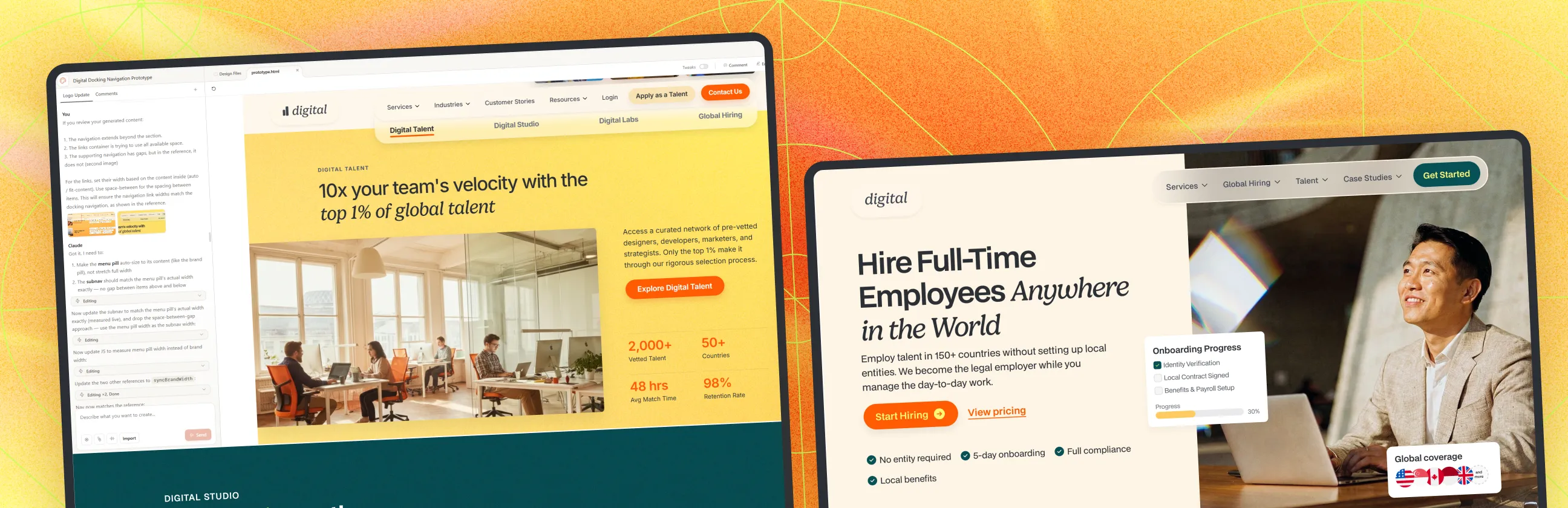

Tools like Claude Design are reshaping the middle. In a single working session, Claude Design generates a credible structural starting point for a landing page. The team decides what to do with it. The development team aligns on behavior before any production work starts. The middle isn’t faster. It’s a different shape. What brand teams should expect from the people they hire is changing too.
Where the middle used to be
Every brand or marketing project has the same shape. Someone writes a brief. A designer turns it into static mockups. The team reviews. Someone has feedback. The designer revises. The team reviews again. Eventually a version gets approved and a developer receives a file with annotations explaining what should happen between the frozen frames.
The brief and the launch are not where the time goes. The middle is. The reviews multiply because static frames cannot show motion or behavior, so the team fills the gap with words. Words misalign. Misalignment compounds across rounds. By the time something ships, the version on screen has drifted from the version that lived in anyone’s head when the work started.

What changes when the middle compresses
Three things happen at once when the middle of the work shortens.
- The cost of seeing a direction before committing to one. Producing a second visual direction used to mean another round of design time, which is why most teams committed early. Now the team sees a direction in minutes, evaluates it, and chooses to go with it or against it before any production work begins. Selection, not generation, becomes the constraint.
- The gap between design and behavior. Static frames cannot show how a thing moves, responds, or sits inside the rest of an experience. Designers fill that gap with words. Developers interpret the words. The interpretation drifts. An interactive prototype removes the words from the middle. The development team sees the behavior, not a description of it.
- The shape of stakeholder review. When the artifact is felt rather than imagined, the questions in the room change. Reviewers stop asking the designer to clarify intent and start reacting to the experience itself. The conversation gets shorter and the decisions get sharper.
None of this is faster mockups. It’s a different middle.
Two places this showed up at Hire Digital
Landing page work is one of the things Hire Digital ships. Inside that work, Claude Design has earned its place in two ways. As a starting point when we want a credible first version against the brand. And as an interactive prototype when the design lives in Figma Design but the behavior doesn’t. Two illustrations, two facets, both happened on the Global Hiring sub-brand.
Generating an EOR landing page
The Global Hiring sub-brand is expanding with an Employer of Record (EOR) page. Hire Digital pointed Claude Design at the Global Hiring URL as the brand reference and asked it to design the new sub-page. Claude produced a good first version close to the brand.


Claude Design’s first version was close to the brand and had the structural composition working. The hero was credible. The supporting panels were in the right territory. The Hire Digital design team took it into Figma Design and developed it from there. Photography replaced the UI mockup direction. The floating UI cards stayed but got refined. The result is a different page, but it started with what Claude Design produced.

The takeaway: Claude Design got us to a credible starting point in minutes. The designer’s craft made it shippable.
Prototyping the docking nav
When Hire Digital restructured its homepage into four core services (Digital Talent, Digital Studio, Digital Labs, and Global Hiring), a key design challenge emerged: how the new docking navigation should behave as a user scrolls. The static layout was complete in Figma, but the interactive motion wasn’t. That is where Claude Design earned its place.
Claude Design’s Present mode opens the prototype in fullscreen or a new tab. The team experiences the docking nav the way an end user would, scrolling, hovering, watching the pillars dock as the page moves. Not a mockup with a play button. A working surface.


The first prototype wasn’t the final one. The Hire Digital team gave Claude Design specific design feedback: the navigation extending beyond its section, the link spacing not matching the reference, the supporting nav gaps. Claude Design fixed them. The team agreed on the behavior in the same session it took to brief the problem.

Claude Design didn’t produce the production code or replace Figma as the design source of truth. It produced the artifact the development team needed to align before either of those steps started. The four-pillar nav is live at hiredigital.com.
The takeaway: Static frames described the behavior. The prototype let the team feel it.
Three patterns brand and marketing teams will recognize
- Briefing a hero refresh. You used to scope the brief to what production could carry. Now you scope to what the team can choose between. The constraint moves from how many you ask for to how many you can compare.
- Presenting to the exec team. The clarifying questions used to take half the meeting before the real conversation could begin. Now the prototype answers them before they get asked. The conversation becomes the conversation about the work, not the conversation about what the work means.
- Shipping a landing page. The annotation document said “subtle parallax” and the dev team built something that wasn’t subtle. With an interactive prototype, the dev team builds against behavior they’ve seen, not behavior they’ve interpreted. Fewer rounds. Less drift.
The takeaway: The patterns aren’t future hypotheticals. They’re already happening on real work.
What still needs human judgment
This isn’t the AI-replaces-designer story most coverage tells. We use Claude Design inside how the team already works. The designer stays. The judgment stays.
Three honest limits live underneath that framing.
- Photography and visual texture happen elsewhere. Claude Design fills image slots with stock or HTML approximations. Real campaign photography, custom imagery, logos, illustration with a point of view, all of that still happens outside the tool.
- Production polish happens elsewhere. Claude Design produces first drafts and interactive prototypes. The polish that separates a brand from AI sameness still happens in Figma Design or in a designer’s head.
- The reading of the output still requires designers. When AI generates a polished mockup in seconds, the design conversation that produced it is missing. Selecting between directions and recognizing when a mockup is technically correct but aesthetically blind is still the designer’s job. Like every serious AI workflow tool, Claude Design has real operating costs in time and tokens. We plan around them.
The takeaway: Tools handle production. Taste handles direction.
Two illustrations on the same sub-brand. Three layers of work between brief and ship.

The bottom line
The middle of the work was where the time went. Now the middle is where the judgment lives.
Tools change. Taste doesn’t. The advantage in 2026 belongs to teams who use AI to compress production and spend the recovered time on judgment. That’s the only AI claim worth making.