


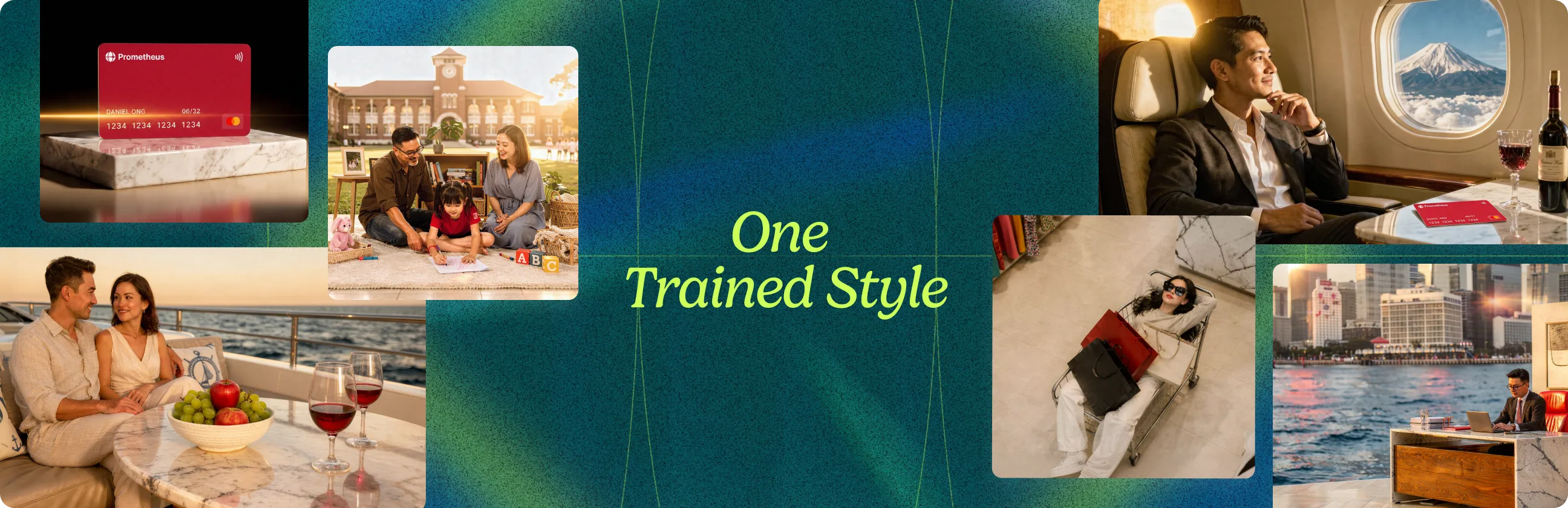

On 28 April 2026, Magnific unified its full AI creative stack under one name. Two weeks later, we ran a controlled experiment inside the new platform to test the ceiling of trained custom styles. The setup: a premium banking brand built from scratch, around twenty curated reference images, one custom style trained to hold a red and matte black palette across multiple output types. The results show the method handling lifestyle, product, and concept output from the same trained style without the brand wandering between generations. The post walks through the workflow, the dataset, the production pattern, and four limits we hit along the way.
The Brief
The brief we constructed mirrors what we typically see from premium brand clients. A banking brand needs to build awareness with high-value cardholders across web, social, and paid channels. The work calls for lifestyle, product, and concept imagery in a single locked register (lighting, materials, palette, atmospheric mood), scaled across multiple markets. Volume, speed, and consistency are the constraints, not the budget for a single hero shot. We used this brief as the controlled scenario for the experiment.
What We Built
The constraints were strict. Red as the primary identity color. Matte black as the support. Warm directional light, deep shadow as the signature. An editorial register pulled from luxury magazine photography, not financial services creative. The work needed to stretch across three output types without losing the brand at any step.
If you have produced AI imagery at brand scale, you already know how this usually goes. The first ten generations sit on-brand. By the fiftieth, the palette has wandered. By the hundredth, the campaign reads like three different agencies. The fix is not better prompting. The fix is structural.
To find out how far the trained style could stretch, we generated three distinct output types from the same dataset. Each one is evidence of a different kind of range.
Lifestyle. Premium moments where the brand shows up. A private jet in transit, a curbside payment moment, a couple at leisure at the close of day, a hand mid-tap at a marble bar counter. The product appears in real moments of use, in environments where a premium cardholder actually lives. This output type proves the method handles human moments and the trained style holds across web hero shots, social campaign assets, and OOH (out-of-home advertising) placements.

Product. The card as the subject. Two registers were tested: a studio hero with the card upright on a polished white marble plinth and a warm rim light tracing the long edge, and a contextual placement with the card laid flat on the bouclé upholstery of a designer chair as if just set down. With or without environment, no humans in frame. This output type proves the method handles both isolated hero treatment and lived-context placement, the kind of image that would deploy as a homepage product feature, pitch deck cover asset, supporting campaign visual, social post, brand book asset, or premium print placement.

Concept. Visual narratives that dramatize the brand promise. The brand at the start of a young executive’s career, the brand inside the moment a family invests in the next generation. Concept imagery is the most symbolic register and the hardest to brief, which is where a trained custom style earns its keep. These outputs deploy as brand film key art, above-the-line campaign heroes, and premium print placements.

The takeaway. Three output types, one trained visual register, the brand language holding across every generation. This is the range a trained custom style can deliver.
The Workflow
The workflow takes references to a trained style in five steps.

The brand lives in the dataset. The prompts handle the staging. The trained style is shorthand for the brand register, so the prompts get shorter.
Inside the Process
- Gather references (visual direction). Collected around twenty images that capture the brand’s lighting, color, and material language. Scenes only, no card, no people in frame. Most teams skip this filter on the first pass and pay for it in training drift.
- Build the dataset. Filtered the references down to the cleanest set of around twenty. Same lighting direction, same palette, no off-brand intruders. The dataset is a recipe, not a pile.
- Train the style. Uploaded the dataset to Magnific, named the style, let it train. Around five to thirty minutes depending on quality tier.
- Generate. Wrote prompts placing the card, the hands, and the scenes into the world, then applied the trained style at generation time.
- Iterate. Generated several variations per prompt, kept what worked, refined the prompt or the dataset if anything drifted.
The takeaway: A trained custom style is shorthand for the brand register (lighting, materials, palette, atmospheric mood). Without it, prompts need a 200-word style description in every generation. With it, the same look comes from a few key phrases.
Building the Dataset and Custom Styles in Magnific
This is the step where most custom style work fails quietly. Brand drift starts here, and a clean dataset is the only real fix.
How custom styles work on the platform
Magnific uses LoRA training (Low-Rank Adaptation). Small fine-tuning layers learn an aesthetic from a curated set without retraining the whole base model. The UI flow takes four moves.
- Curate the set
- Create the style and describe it
- Train the LoRA (usually takes five to thirty minutes)
- Apply, test, refine, repeat
A few platform specs worth knowing. The dataset size sweet spot is twelve to twenty-four images. Resolution should sit at 2,000px or more on the long edge. The supported base models for Custom Style training are Flux.1 and Mystic. The trained style can then be applied at generation time with newer base models from the Flux 2 family. In production we generate with Flux.2 Max for the highest fidelity, with the trained Custom Style applied as a reference layer alongside the card design.

The model family worth knowing about is Flux 2 from Black Forest Labs, which Magnific runs in its generation stack. Flux 2 models understand HEX (hexadecimal) color codes directly in prompts. For a premium banking brand obsessed with a specific red, writing #C8102E inside the prompt now does what a hundred-word style description used to attempt. The trained style biases toward the brand’s lighting register. The HEX code locks the exact color. Both make precision easier from shorter prompts.
What the dataset should actually contain
Custom Styles train scenes, not subjects. The dataset should be scenes only. No humans in frame. No card. If either ends up in the training set, the model overfits and starts inserting them into unrelated generations, which is exactly the kind of drift you trained to avoid.
For around twenty images, the split mirrors the output use cases. The bulk of the dataset trains the environments where the most generation volume will land.
- Lifestyle environments. Premium spaces where a cardholder actually lives the brand. Hotel bar counters at night, executive lounges, private dining rooms, luxury car interiors, first-class lounges, members’ club spaces. Empty in frame, warm directional light, on-palette. The largest bucket, because lifestyle is the highest-volume output.
- Surface environments. Clean surfaces ready for the card and supporting objects to land on. Dark marble desks, polished black stone, brushed bronze plinths, matte black tabletops. Each one staged for top-down or angled placement, with a clear pool of warm light and deep shadow at the edges.
- Product photography. Hero-object lighting against deep matte black. Plinths, floating compositions, macro framing. The dataset teaches the model how a single object should be lit when there is no environment to anchor it.
Concept imagery doesn’t get its own training bucket. Concept is a prompting strategy, not a training discipline. The same trained style produces concept outputs through narrative prompt direction, including surrealist compositions that place staged interiors inside larger environments. The style holds the brand register; the prompt builds the narrative.

Quality checklist
Every image in the set should pass six checks. Resolution 2,000px or more on the long edge. Red and matte black dominant, no random palette intruders. Lighting direction consistent with the brand signature, warm and directional with a single source, deep shadow at the edges. No watermarks, text, logos, or UI overlays. Editorial tier, Vogue or Wallpaper feel, not stock, not amateur, not the artisan café aesthetic. A mix of close-up, mid, and wide shots across the set so the model generalises.
What causes drift
People in frame, even partial, even just hands. The actual credit card or card-shaped objects so close that the model conflates them with the hero. Visible logos or other brand cues. Text and watermarks. Daylit, flat, or fluorescent lighting. Off-palette colors. Cluttered scenes. Stock-photo or wedding-photography aesthetics. Each of these moves the trained style toward AI sameness, the visual middle every model defaults to without direction.
The takeaway: The dataset is the brand. The prompts are everything else.
The Styles in Action
These are the outputs that mark the ceiling of what the trained style can deliver. The trained style applied at generation. Across all these outputs, the brand register holds because the style biases the model toward it. The prompts handle what changes per shot.
A production prompt looks like this:

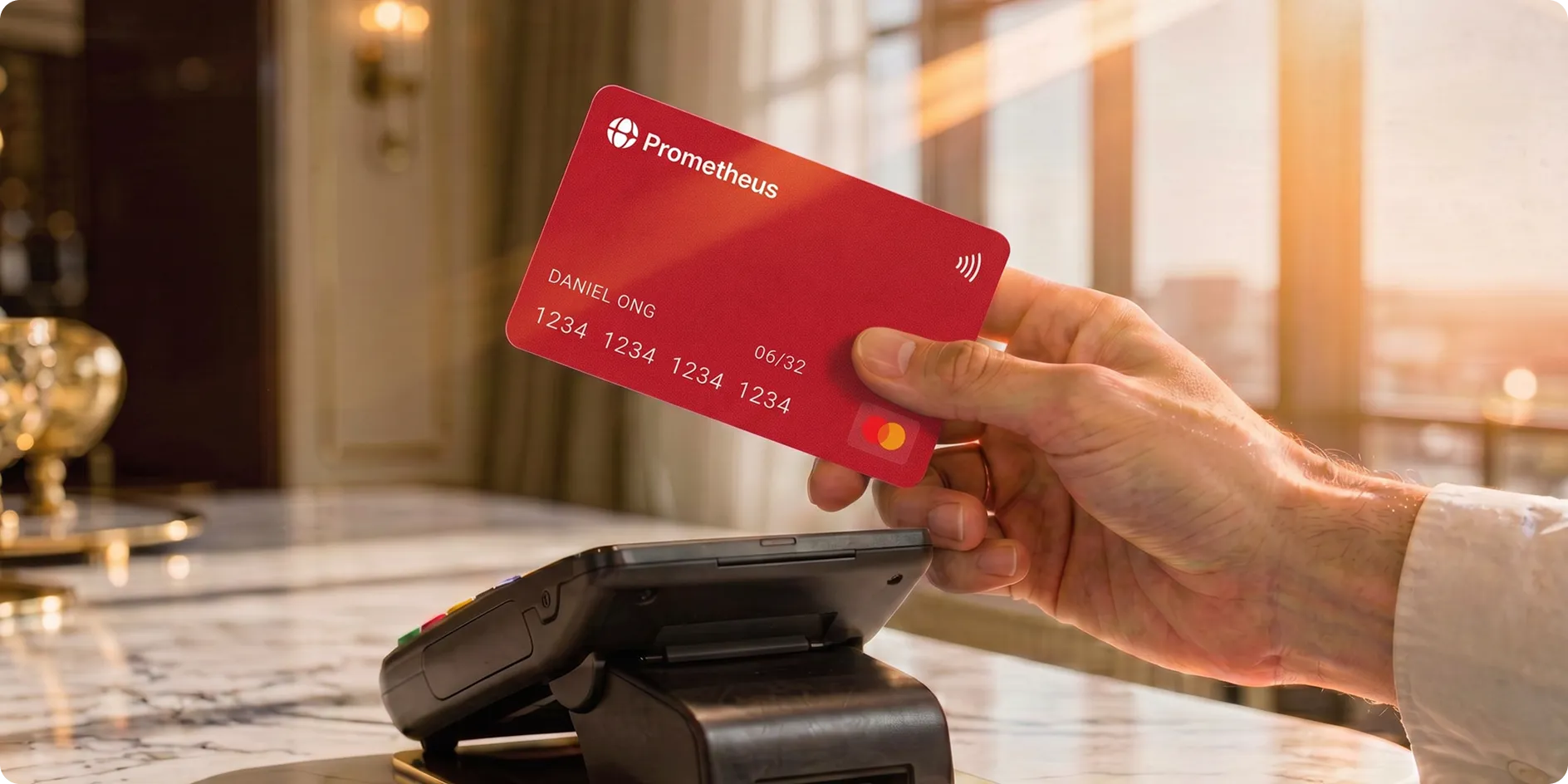
The trained style carries the brand register. Each prompt handles what changes — subject, action, scene — and the look holds across every generation.

The takeaway: Prompts are tactics. The trained style is the strategy.
The Card Handoff
When an experiment like this becomes client work, the production workflow runs three controlled inputs at generation time. The trained Custom Style biases the model toward the brand’s register: lighting, materials, palette, editorial mood. A reference image of the actual card design, dropped into the prompt as @img1, locks the card itself: exact colors, exact typography, exact contactless symbol placement. The prompt holds the action: the hand, the terminal, the moment of tap.
Trained style. Reference image. Prompt. Three inputs, one output, brand-locked at every layer.
This is the difference between AI generation as a single-pass guess and AI generation as a controlled production pipeline. The card design never drifts because the model never tries to invent it. The card lives in the reference layer; the trained style biases the world; the prompt directs the scene.
The takeaway: The card is a reference, not a guess.
Honest Limits
A custom style is not a creative director. Four limits we hit during the experiment, all worth naming up front for anyone thinking about running this kind of work for their own brand.
- The card itself drifts across generations. Custom Styles learn the visual language, not specific objects. If the model is asked to generate the card from the prompt alone, the design will vary subtly from generation to generation: chip placement, embossing depth, edge treatment, the way the foil catches light. Two fixes, depending on how much production rigor you need. The simpler fix is reference image conditioning. Drop the actual card design into the prompt as a reference and let the trained style place it into the scene, which is what we do in production and what the Card Handoff section above describes. The heavier fix is LoRA stacking. Train a separate Custom Object on the actual card design, then run both at generation, with the Style supplying the brand language and the Object supplying the design. Add a HEX-coded prompt for color precision. Style LoRA plus Object LoRA plus HEX-coded prompt is the production-grade stack premium brand teams now run when reference conditioning alone is not enough.
- Real people, real places, and real brand assets stay out of reach. If the campaign needs a recurring spokesperson, train a Custom Character. If the campaign needs a specific physical location, a flagship branch or a real cardholder event, that is still photography work. AI image generation gets you a stylistically convincing fictional environment, not a verifiable real one. Regulated industries should treat this distinction as a hard line.
- The dataset has a half-life. Brand aesthetics shift. Lighting trends evolve. The trained style is a snapshot of the brand at the moment of training. Plan to retrain every six to twelve months as the visual language updates, especially when the underlying base model gets a major release. A Flux-trained style does not transfer cleanly to a different base, so a model change means a retrain.
- Every image still needs a final design pass. Typography, logo lockups, and the precise application of a brand system remain unreliable out of any model, trained or not. Custom Styles get you to roughly 80 percent. Design closes “the last 20.”
From scene to brand

The brand used to live in the photographer’s eye. Now the brand lives in the dataset. Models change. Curation doesn’t. The advantage in 2026 belongs to brand teams who curate before they prompt.
AI visual consistency is not a prompting problem. It is a system problem. That’s the only AI claim worth making.