


Global Brand, Local Content: How Do You Make Your Brand Relevant to Local Audiences?

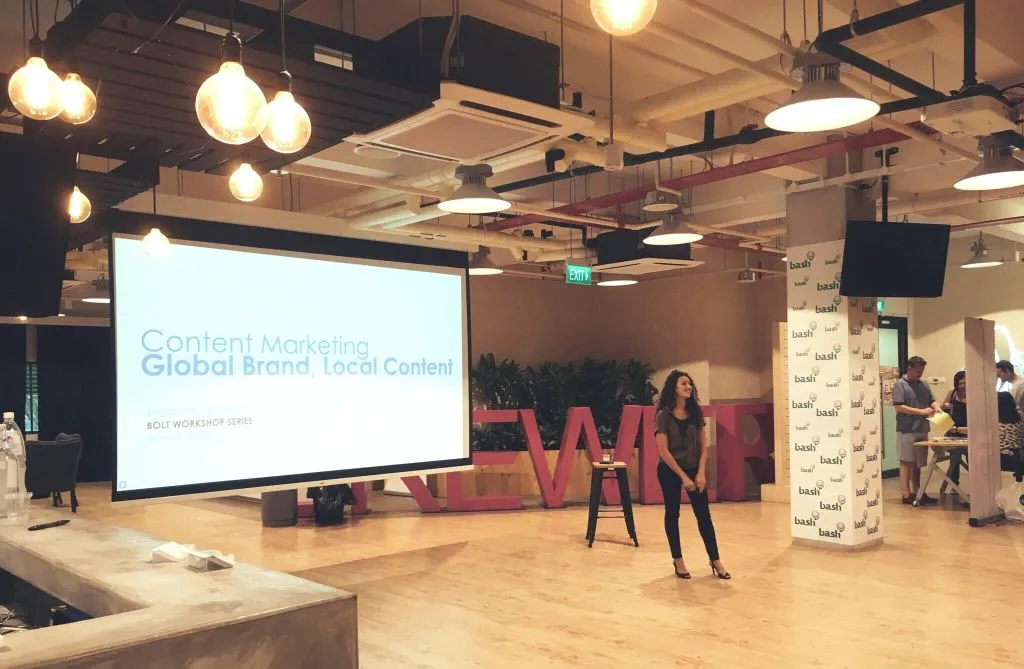
Content.co had the privilege of hosting a workshop conducted by global strategist Adela Villanueva, where she talked about making global brands and content relevant to local audiences.
Adela has over a decade’s worth of experience in the advertising and marketing industry, working at top agencies to formulate brand strategies for huge international corporations like Philips, McDonald’s, and Lego, just to name a few.
Here’s a quick recap of what went down:
Is Localising Global Content Necessary?
Adela’s answer to this: yes and no, as far as it is relevant.
I know, sounds a lot like a cop-out. But what’s key is that content has to be consumer-centric, so the answer to this always revolves around relevancy to the audience.
You want to create content that is understood by, resonates with, and adds value to your target audience. And instead of being interruptive, you want your content to become embedded in consumers’ conversations.
For that to happen, your content must sit well within the cultural context. Otherwise, it won’t initiate the kind of action that marketeers want.
Translation Vs Language
Localising content is not simply a matter of translation. To create good content that is relevant to local audiences, we need to focus on consumers. This means taking into account various factors that affect the way they interpret and interact with content.
First, it’s essential that we be mindful of not just about what we talk about, but how we talk. To communicate with local audiences effectively, we need to use their language, terms and references. This is the only way we can become a part of their conversation.
Contextual Considerations
Next is to pay attention to the specific cultural context of the particular community or society you want to talk to. To be relevant to local audiences, think about how your content will be situated within that particular culture.
When using visuals – faces, colours, shapes or symbols – always be mindful of what your audience responds better to, and what they might associate with these images.
In Singapore, for instance, audiences prefer seeing Asian rather than Caucasian faces in content. Even hand gestures are important – what is normal in one culture might be considered a dirty sign in another.

Consider the little nuances of what you should/can talk about. Be mindful of timezones, seasons and currencies, to make sure things don’t get lost in translation. For example, it’s probably not a great idea to use a skiing analogy to Singaporean audiences, because the sport isn’t very popular (especially given our tropical climate).
Make sure to be sensitive when operating in dark markets. Don’t talk outrightly about alcohol – which is considered haram – in Malaysia or Indonesia, or about sensitive political topics beyond Singapore’s OB markers.
Also take note of the level of technology and how that might affect the types of content local audiences consume. For instance, if internet/mobile data speeds are low in a certain country, then you shouldn’t be relying on video content, which takes a long time to buffer. In that instance, consider using text or articles to deliver your content instead.
The Importance of Perceptions
Be mindful of how different audiences might perceive your brand. For example, homegrown beer company Tiger presents itself as a source of national pride in Singapore messaging. On the other hand, because it is seen as an Asian beer in Europe, content produced for that context tends to connote exoticism and some degree of Asian mysticism or “power”.
Don’t Lose Who You Are
Lastly, even as you localise and adapt your message, always remember to keep your brand voice. Don’t try to be somebody that you’re not, because audiences won’t appreciate it.
Going Glocal

For those unfamiliar with the term, being glocal simply means marrying global and local approaches to suit your target audience. For instance, McDonald’s adopts a glocal approach to its menu, by offering local spins on international items, to suit the local palette.
When it comes to content, a glocal approach could involve both creating unique local content pillars, and adapting global pillars to suit the local context.
Channels and Platforms

But how about delivery? Of course, you should distribute your content on channels that are popular among your target audience. For instance, if you want to reach consumers in China, you obviously shouldn’t plan a Facebook campaign to do it – since China blocks access to the site.
It’s not just about which platform has the largest number of users. Fish where the fishes are, but also where they are eating. That means a platform where you’ll not only have great reach, but also meaningful engagement with your consumers.
Ultimately, Adela’s advice was to focus less on the platform and more on the content, and the communities you want to reach with that content.
Creating Global Content from a Local Brand

By way of conclusion, Adela moved on to a final question: can we create global content from a local brand?
Her answer: yes and no, as far as it is relevant.
The secret recipe, she pronounced, is to put the consumer first, not your brand. Whether you’re speaking to global or local audiences, the most important thing is to treat them as cultural beings, and understand what moves them internally and externally.
Reach Local Audiences with Content.co
For international and local brands, it’s often hard to find good local writers to help establish your brand voice in local markets – whether in Singapore or the Asia Pacific region.
Content.co can help! We connect brands with experienced local storytellers who can help you make inroads in local content.
Click here for more info, or email us at enquiry@content.co to talk to us about how we can help you scale your content and digital marketing with our exclusive talent network.